

Professional Air Duct Cleaning Equipment


At DuctPro, we design professional air duct cleaning equipment around real-world field requirements. Our team combines more than 15 years of large-scale commercial and government duct-cleaning experience with more than 22 years of hands-on industry experience, including NADCA-certified technical expertise.

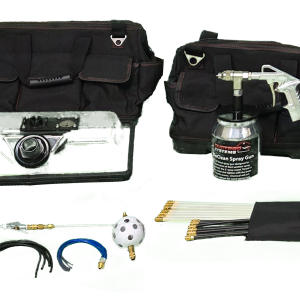


DuctPro Systems is approved to perform Federal, State, and Local Government work, reflecting a commitment to professional standards and quality. No two duct cleaning projects are the same, and that’s where we come in. One phone call is all it takes.


DuctPro Systems designs professional portable air duct cleaning equipment for contractors who need power, mobility, and flexibility across residential and commercial jobs. While truck-mounted systems can cost $30,000–$70,000 and deliver high extraction capacity, DuctPro offers a more accessible professional solution built for contractors who value easier access, shorter hose runs, portability, and a lower overall equipment investment. Our systems are designed around real-world jobsite demands, helping contractors handle a wide range of duct-cleaning applications without the cost and limitations of a dedicated truck-mounted setup.


Over the years, valuable feedback from DuctPro™ customers has helped shape and refine our duct cleaning systems. Many of our customers have secured residential, commercial, and governmental projects, growing their businesses beyond what they once thought possible. In today’s market, duct cleaning services continue to outpace much of the service-based industry.


At DuctPro Systems, professional equipment is only the beginning. We believe contractors need the knowledge, training, and ongoing support to get the most from their equipment and confidently perform professional air duct cleaning services.
Our team brings decades of real-world duct-cleaning experience to every system we sell. DuctPro provides hands-on training and practical guidance covering equipment setup, proper cleaning techniques, system operation, jobsite procedures, maintenance, troubleshooting, and best practices for residential and commercial applications.
More importantly, our support does not end after the equipment is delivered. DuctPro customers have access to experienced professionals who understand the equipment because we’ve used it in the field. Whether a contractor has a question on their first job or needs guidance years later, our team is available to help.
Our goal is simple: provide contractors with more than professional duct-cleaning equipment. We provide the training, experience, and long-term support needed to confidently put that equipment to work and build air duct cleaning into a successful part of their business.


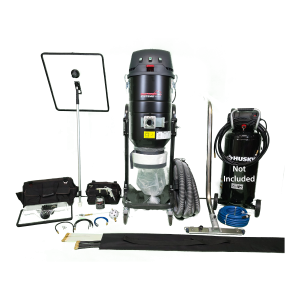
All you need to get started!
Learn more about Complete Duct Cleaning Equipment Package
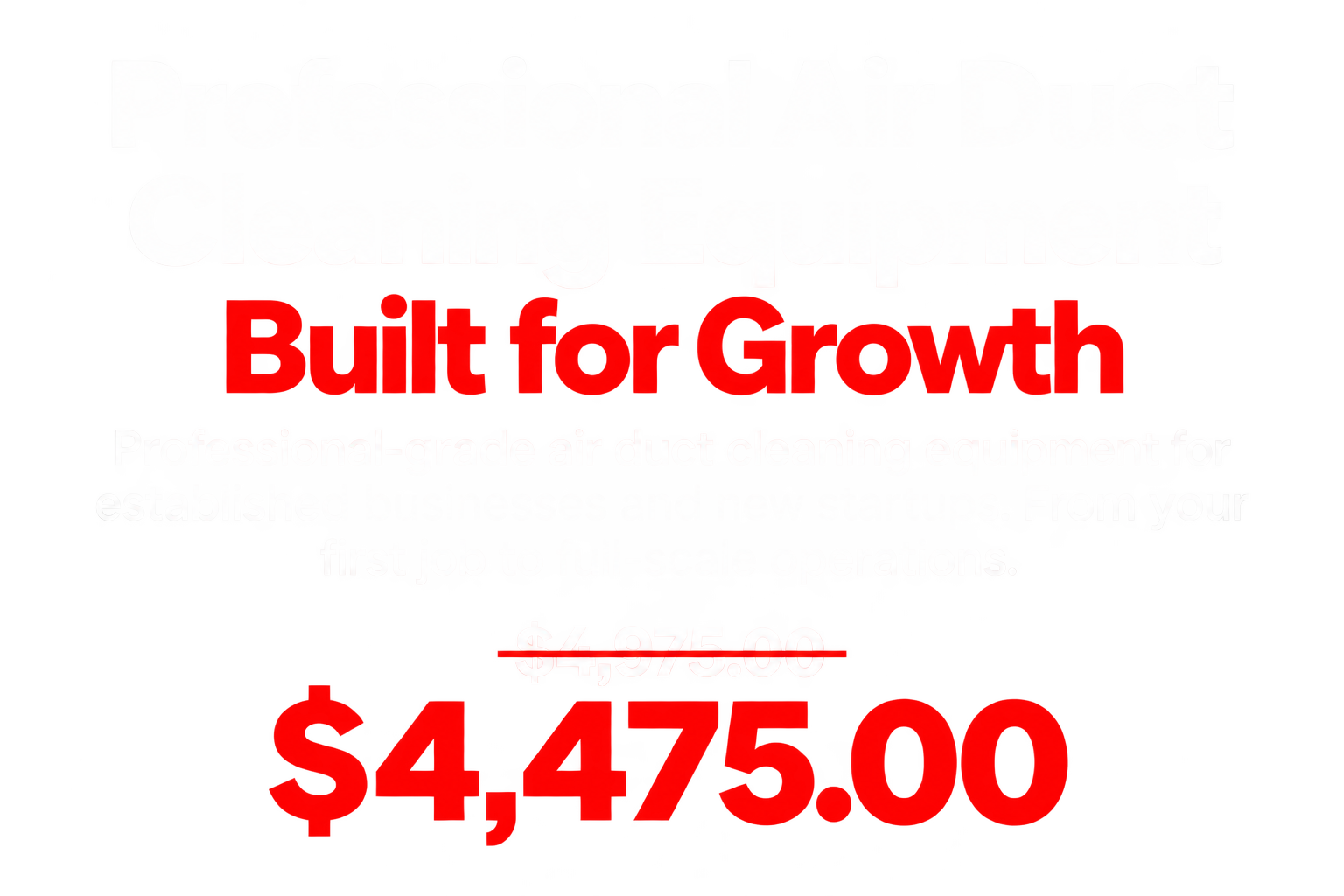
$4,885.00 $4,475.00



With existing equipment, your ready to get started!
Learn more about Basic Duct Cleaning Equipment Package
$2,385.00 $2,185.00


DuctPro™ Duct Cleaning Equipment mentioned on World Media
As Seen In




How Professional Air Duct Cleaning Equipment Fits Into the Cleaning Process

As a duct cleaning contractor, it is your job to ensure a client’s ductwork is cleaned properly. Knowing the best practices will give you the confidence to guarantee your customers quality service.
Air duct cleaning methods vary, but associations like NADCA have established some much-needed standards. Generally, ductwork cleaning companies’ clean HVAC systems in four steps:
- Accessing the system
- Loosening the contaminants
- Collecting the debris and
- Sanitizing the ductwork
Accessing the system
Not all premises offer easy access to ductwork. Therefore, getting to the ducts that need cleaning can require significant effort.
The easiest way to access duct interiors is through existing openings. These can be supply diffusers, return grills, or duct end caps. You may also need to cut entry holes in the duct pipes to get inside with the cleaning tools.
Loosening the contaminants
Once you gain access to the ductwork, the next step is dislodging the dirt stuck on the air duct walls. For effective loosening, you need specialized agitation devices.
Depending on the severity of the contamination, you can use rotary brushes, air whips, or compressed air nozzles. You can also dislodge a considerable amount of debris through hand-brushing and contact vacuuming.
Tri-Motor Vacuum
Collecting the debris
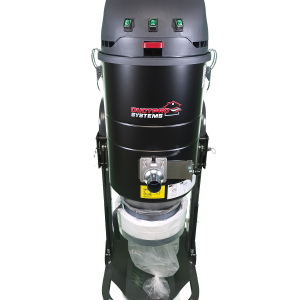
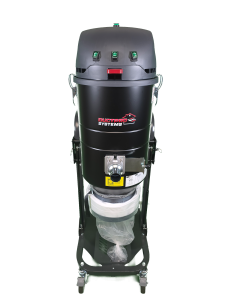
During the agitation process, you must place the entire HVAC system under a continuous vacuum. Suitable vacuum systems range from massive truck-mounted machines to portable equipment like DuctPro™’s Tri-Motor unit.
Connecting the vacuum to the duct trunk creates negative pressure in the ductwork. In this environment, the dirt being dislodged cannot spread in the duct or escape into the living space.
The vacuum conveniently sucks out all loosened contaminants and collects them into a specialized holding bag or drum.
DuctPro Tri-Motor Vacuum Specifications
- Airflow: 330 CFM
- Air Watts: 900
- Water Lift: 220 inches
- Motor Configuration: Three independent vacuum motors
- Debris Capacity: 12 gallons
- Hose: 25 ft. black 1½-inch suction hose
- Hose: 25 ft. gray 2-inch suction hose
- Floor Tool: Stainless steel floor wand squeegee
- Protective Equipment: Lightweight protective vacuum dolly
Sanitizing the ductwork
An air duct cleaning operation can also include applying chemical biocides to nonporous surfaces in the HVAC system. These chemicals can be sanitizers, disinfectants, or deodorizers.
Only consider using these products after you have cleaned the ducts mechanically by agitation and vacuuming. That way, you will be sure that chemical treatment is needed.
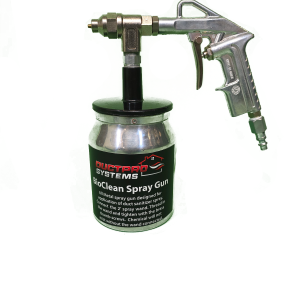
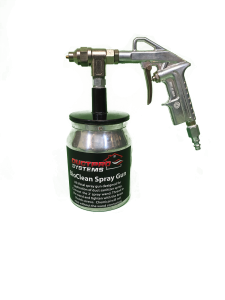
BioClean Duct Spray Gun
Our BioClean Duct Sanitizing Sprayer Gun puts duct sanitizing chemical directly to the duct walls and allows more BioChem to be applied than the much used fogger unit. Our system allows you to control the amount of liquid to the areas that are most important. The “end-of-line” ducts at the register opening is where the air pressure is low and one of the high worry of dirt build up. This is why there is a need for increasing the chemical sanitizer is critical for proper duct sanitizing.
Our System Includes:
- BioClean Sanitizing Sprayer
- 24-inch Duct Spraying Wand
- Durable Protective Case
DuctPro Equipment and Tools Explained
Knowing how to clean ductwork is only one half of the coin. The other is having all the air duct cleaning equipment you need to do the job. A successful duct cleaning operation will typically involve the use of several different types of equipment. Today professional duct cleaners use the critical tools given below.
Access Tools
Access tools are devices that HVAC technicians use to create entry points in the ductwork. These points allow them to inspect and clean the inside of the duct pipes. They may range from tiny holes for optical imaging, to entryways that are large enough to fit service personnel and bulky equipment.
To create minor access points, you would likely need a drill with a one-inch drill bit. For greater access, you might utilize pneumatic cutters and electric shears.
Inspection Tools
You can use a visual inspection device to evaluate the debris accumulation within an air duct. The right inspection gear can also help you to monitor the cleaning process and assess the success of your methods. Some standard tools include hand-held mirrors, periscopes, and CCTV cameras.
Cleaning Tools
Cleaning tools come in different shapes and forms. However, their general purpose is the same: to agitate the debris and dislodge it from the air duct walls. Once removed, the contaminants can be propelled toward the containment system.
The most popular professional cleaning tools are rotary brushes, air guns, and air whips.
Air Guns
You can use a high-powered air gun to “air-wash” surfaces like register covers. Air washing pushes debris into the vacuum.
Air Whips
An air whip can come in handy when loosening stubborn dirt. Its plastic tentacles will thrash aggressively against the walls of the air duct.
The tentacles are usually equipped with nozzles. The air blasts from these nozzles are incredibly useful in pushing dislodged debris toward the collection device.
Vacuum Collection Devices
Vacuum units create negative pressure in the HVAC system to control the movement of contaminants when cleaning. Depending on the size of your operation, you can utilize either a truck-mounted vacuum system or a portable wheeled vacuum.
Truck-mounted equipment generally provides more power than a portable unit. However, you can position a portable vacuum closer to the ductwork. Furthermore, a portable vacuum works with a shorter hose. It therefore loses less suction power than a truck-mounted machine.
Compressors
Many tools used in air duct cleaning are pneumatically powered. A compressor is therefore a necessary support machine. Air guns and air whips rely on the air pressure a compressor supplies. Compressors are usually truck-mounted. Portable varieties are available for use in worksites where truck access is limited.
Many duct-cleaning tools are pneumatically powered, including air whips and air guns. DuctPro’s Operation Manual specifies an operating pressure range of 120–175 PSI for compressor-supported cleaning procedures.
Air Duct Cleaning Tool Job site video from DuctPro™
Frequently Asked Questions
Question: Can portable air duct cleaning machines handle large jobs?
Yes, portable professional equipment can be suitable for large residential and commercial projects when the equipment, hose configuration, access strategy, agitation method, and cleaning procedure are appropriate for the job. Equipment selection should be based on the specific HVAC system rather than assuming that one vacuum configuration suits every project.
Question: Is HEPA filtration important in air duct cleaning equipment?
Yes, HEPA filtration is important in professional air duct cleaning equipment because loosened dust, particulate matter, and other contaminants need to be captured and contained rather than redistributed into the surrounding environment. Proper filtration also helps protect the vacuum system during extraction. Contractors should follow the manufacturer’s instructions for filter installation, cleaning, replacement, and maintenance to maintain effective filtration performance.
Question: Can professional duct cleaning equipment remove mold and bacteria?
Professional duct cleaning equipment can remove physical debris and contamination from appropriate HVAC surfaces through mechanical agitation and extraction, but equipment alone should not be described as eliminating all mold or bacteria. Microbial contamination requires appropriate assessment and, where necessary, a properly selected treatment. Any chemical product used for treatment should be applied according to its label and applicable requirements.
Question: Can one person operate a complete air duct cleaning system?
Yes, one person can operate some portable air duct cleaning systems depending on the equipment configuration, building layout, access requirements, and scope of the job. However, larger or more complex projects may require additional technicians for equipment handling, access, containment, agitation, and other tasks. Staffing should be determined based on the specific requirements of each project.
Question: Is duct cleaning equipment worth the investment for a new business?
Yes, duct cleaning equipment can be a worthwhile investment for a new business when there is sufficient local demand and the equipment is matched to the contractor’s intended workload. Contractors should consider equipment cost, expected job volume, pricing, labor, maintenance, marketing, and local competition when evaluating the investment rather than assuming a fixed payback period
Field Reports
What contractors are seeing after they add DuctPro
DuctPro has come up with a system that allows me to integrate duct cleaning into our HVAC repair & maintenance. It has created additional income that I hoped for, and it has paid for itself in a month.
I recently purchased air duct cleaning equipment from DuctPro Systems, and I couldn't be happier with the quality and performance. The Tri-Motor duct vacuum is powerful, reliable, and makes professional air duct cleaning much easier and more efficient.
You just get more for your money — I researched it, and the vacuum alone sells for $2,700 to $3,400, with the air rods and whips running another $700 on top. Add it up and you save about $1,000 buying the full system instead of hunting down the pieces yourself. More than the equipment though, the staff really helped me start my business — bids, my Google Business account, even setting up a way to land government duct cleaning jobs, one of which was $21K.